
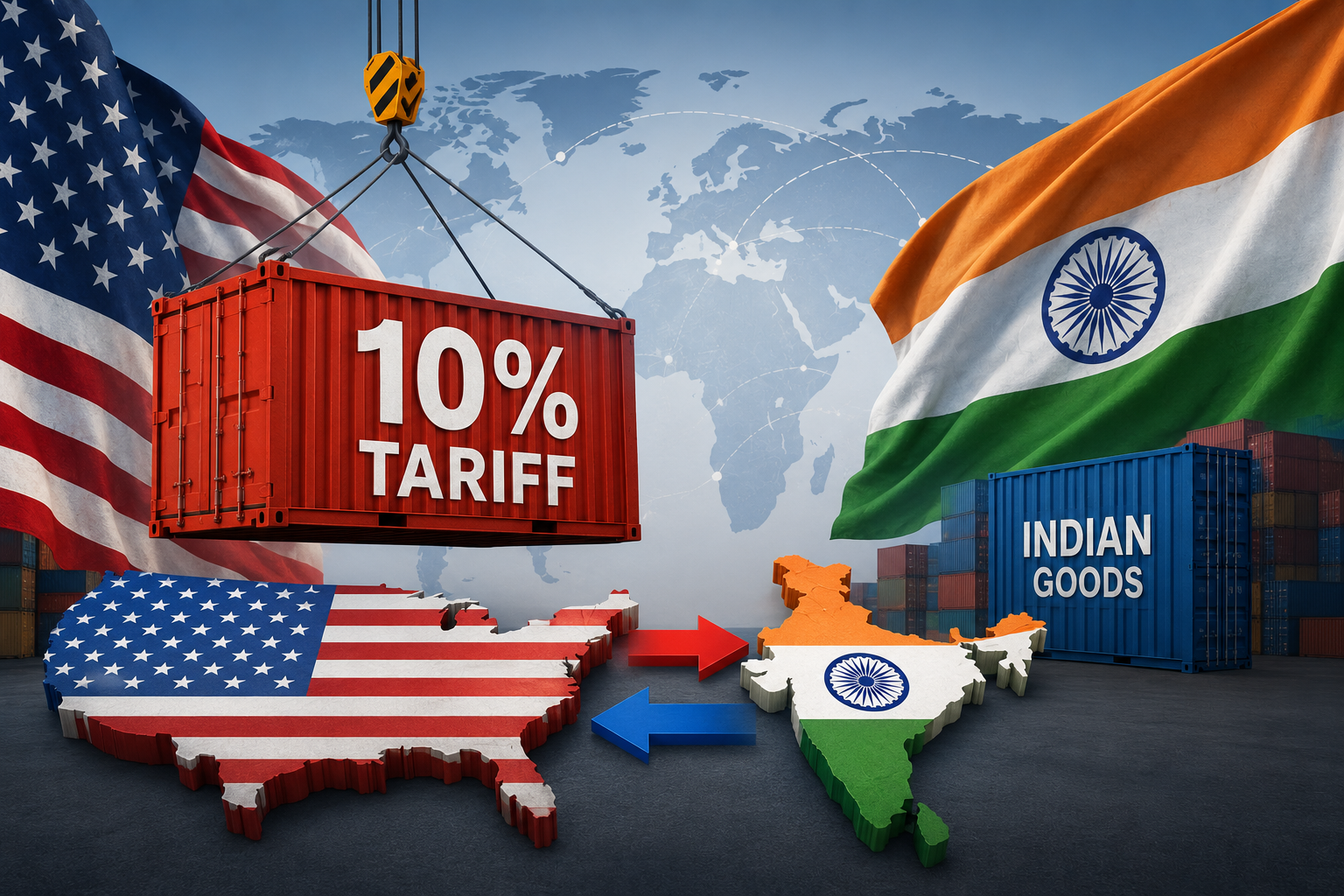
US Imposes 10% Tariff on Indian Goods as Part of Sweeping Duties on 60 Trade Partners

Trump Administration’s Broad Protectionist Move Hits Indian Exporters; Textile, Pharma, Auto Component and Jewellery Stocks Under Pressure
The United States has unveiled a sweeping new tariff regime covering 60 trading partners, under which goods imported from India will attract a 10% duty. The announcement, made by the Trump Administration, marks one of the most significant protectionist measures in recent years and is expected to have a direct impact on Indian exporters and equity markets.
Details of the Tariff Announcement
According to the US trade authorities, the new tariffs form part of a broader “reciprocal trade” strategy aimed at reducing America’s trade deficit and protecting domestic industries. India is among the countries that will face a uniform 10% duty on a wide range of merchandise exports to the United States.
The measure covers multiple product categories, including textiles and apparel, pharmaceuticals, auto components, engineering goods, chemicals, and gems & jewellery — sectors where India has traditionally enjoyed strong export growth to the US market.
Impact on Indian Exports
The United States is one of India’s largest export destinations. A 10% additional duty is likely to make Indian goods less competitive against products from countries that face lower or no tariffs. Exporters fear margin pressure, loss of market share, and possible order cancellations in the near term.
Industry bodies have expressed concern that the move could disrupt supply chains and force companies to either absorb the higher costs or pass them on to American buyers, risking volume loss.
Effect on Indian Stocks
The announcement triggered immediate concern in the Indian equity markets. Stocks of companies with significant US exposure are expected to come under pressure:
Sectors and stocks likely to be negatively affected:
- Textiles & Apparel: Companies with large US shipments may see earnings pressure.
- Pharmaceuticals: Generic drug makers that export to the US could face pricing challenges.
- Auto Components: Firms supplying to American OEMs may experience lower demand or margin compression.
- Gems & Jewellery: Export-oriented jewellery makers are vulnerable to reduced demand from the US.
- Engineering Goods & Chemicals: Companies reliant on US orders may revise growth guidance.
On the other hand, some domestic-focused companies and those with limited US exposure may remain relatively insulated. Import-competing industries in India could theoretically benefit if global trade flows shift, though the overall impact is expected to be negative for export-oriented stocks in the short term.
Government and Industry Response
The Indian government is closely monitoring the development. Officials have indicated that New Delhi will engage with Washington through diplomatic and trade channels to seek relief or exemptions for key sectors. Industry associations are preparing detailed representations highlighting the potential job losses and impact on MSMEs that form a large part of India’s export ecosystem.
Expert Views
Trade analysts have described the move as part of a wider protectionist trend. “A 10% tariff is significant enough to alter cost competitiveness, especially in price-sensitive segments,” said one senior economist. “Companies with high US concentration will need to accelerate diversification into Europe, ASEAN and other markets.”
Market Outlook
In the near term, Indian equity markets may witness selective selling in export-heavy stocks. Broader indices could also face some pressure if investor sentiment turns risk-averse on trade-related concerns. However, long-term impact will depend on the final list of products covered, any exemptions granted, and India’s ability to negotiate bilateral relief.
The development comes at a time when Indian companies are already navigating global demand uncertainty and currency volatility. The new US tariffs add another layer of challenge for exporters and are likely to remain a key talking point for markets in the coming weeks.
