
Deficient Monsoon Pushes Up Food Inflation, But Rural Demand Remains Resilient: Nomura

Rainfall 13% Below Normal So Far; Cereals and Sugar Prices Rise, While Two-Wheeler and Tractor Sales Stay Strong
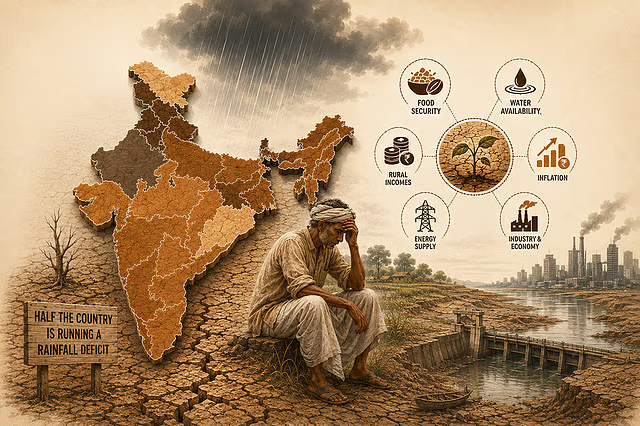
A deficient southwest monsoon has begun to exert upward pressure on food inflation in India, but rural demand indicators have so far held up relatively well, according to a note by Nomura. Cumulative rainfall during the June-September season is tracking 13% below normal as of mid-August, with notable regional disparities and implications for both kharif output and upcoming rabi crops.
Monsoon Performance and Sowing Trends
Rainfall has been uneven. June was sharply deficient at 39% below normal, July recovered to 1% above normal, while August so far is running 14% below normal. The southern and eastern/northeastern regions have been particularly dry, recording deficits of 21% and 27% respectively. Central India has fared better with only a 1% shortfall.
The India Meteorological Department has flagged the possibility of strengthening El Niño conditions leading to below-normal rainfall in the remaining weeks of the season. Reservoir levels stood at 60% of full capacity in mid-August, lower than the 74% recorded a year earlier and slightly below the normal level of 61%.
Kharif sowing is tracking about 2% lower year-on-year. Rice sowing is down 3.7%, while oilseeds, sugarcane and cotton have also seen modest declines. Production-weighted rainfall deviations are most pronounced for jute, rice and coarse cereals.
Impact on Food Inflation
Food prices have risen 5.1% between April and mid-August, higher than the 1.9% increase seen in the same period last year and above the five-year average of 4.6%. The build-up has been particularly noticeable in cereals and sugar. Rice prices have increased despite comfortable buffer stocks, while sugar prices have surged about 9% since April. Vegetable price increases have been more moderate than typical summer patterns, and pulses and edible oils have seen relatively benign rises.
Nomura noted that the deficient monsoon has so far had a bigger impact on food inflation than on rural demand, though it cautioned that these are still early days.
Rural Demand Holds Up
Despite the rainfall shortfall, rural demand indicators have remained resilient. Two-wheeler and tractor sales continued to grow at a double-digit pace in July. However, underlying pressures are building. Nominal rural wage growth has decelerated for both agricultural and non-agricultural workers, and the farming terms-of-trade index has softened as input costs have risen faster than revenues.
Risks to Rabi Season
The monsoon’s performance will also influence the rabi season through soil moisture and irrigation water availability. Lower reservoir levels in northern and southern India could pose challenges for wheat and rabi pulses if the rainfall deficit persists.
Which Indian Stocks May Be Affected?
The developments carry mixed implications across sectors:
Potentially under pressure:
- Sugar companies (Balrampur Chini, Triveni Engineering, Dhampur Sugar) — higher cane costs or production concerns if drought stress intensifies.
- FMCG and food companies with significant exposure to cereals, edible oils or rural volumes could face margin pressure if food inflation remains elevated.
- Fertiliser and agri-input firms may see delayed or lower demand if farmer sentiment weakens.
Relatively better placed or resilient:
- Two-wheeler manufacturers (Hero MotoCorp, TVS Motor, Bajaj Auto) — continued double-digit rural sales growth supports near-term volumes.
- Tractor makers (Mahindra & Mahindra, Escorts Kubota) — strong sales indicate that rural capital expenditure has not yet weakened materially.
- Irrigation and micro-irrigation companies could benefit over time if water scarcity drives greater adoption of efficient systems.
- Select agri-commodity and processing firms may gain from higher realisations in rice or sugar, depending on government policy responses.
Overall, markets will closely watch the final weeks of the monsoon and the government’s buffer stock and import management measures.
Outlook
While rainfall and sowing have improved from the sharp June shortfall, conditions remain underwhelming with significant regional variation. Strengthening El Niño risks add uncertainty to the rabi outlook. Food inflation is likely to stay in focus in the coming months, even as rural demand has so far shown resilience. Policymakers may need to balance inflation management with support for farm incomes and rural consumption.
Nomura’s assessment underscores that the full impact of the monsoon deficit will become clearer only after the season concludes and rabi sowing begins. For now, the divergence between rising food prices and steady rural demand indicators presents a nuanced picture for India’s agricultural and consumption economy.
